
SOUTHPORT, England
Should we be concerned that the governing bodies of golf are getting too immersed in the outcome of major championships?
For the second consecutive major, a subjective two-shot penalty has been handed down to a marquee player, directly altering the landscape of the tournament. When rules enforcement begins to overshadow the play on the course, it raises uncomfortable questions about consistency, discretion, and institutional secrecy.
Last month, the USGA penalized Joaquin Niemann with a two-stroke deduction for a code of conduct violation under Rule 1.2b during the first round of the U.S. Open at Shinnecock Hills. According to the USGA’s brief, two-line public statement, Niemann threw a club on the sixth hole.
While video evidence of the incident exists, it was never shown publicly; the entire situation was effectively swept under the rug. Niemann carded a catastrophic 11 on that sixth hole and signed for an opening 78. He stormed back over the next three days, shooting 65-72-66 to finish in a tie for seventh at 1-over par — just five shots behind champion Wyndham Clark.
It leaves an agonizing "what if" lingering over the championship. Was Niemann’s performance permanently derailed on Thursday by the psychological weight of that penalty? More importantly, does the USGA not have an obligation to show the video evidence used to justify an entirely subjective ruling?
Under the Rules of Golf, a committee has total discretion to issue a warning, a multi-shot penalty, or complete disqualification for serious misconduct. Because this authority is highly subjective, it must be held to the highest standard of transparency. The Niemann ruling was not.
Fast forward to Friday at the 154th Open Championship, where the R&A Rules Committee rolled out Rule 8.1b, which addresses a player's right to fairly take a stance while playing the course as they find it.
The rule allows players to firmly place their feet and engage in a "reasonable amount of digging" in sand or loose soil. However, it explicitly dictates that a player is not entitled to a normal stance or swing and must choose the least intrusive course of action.
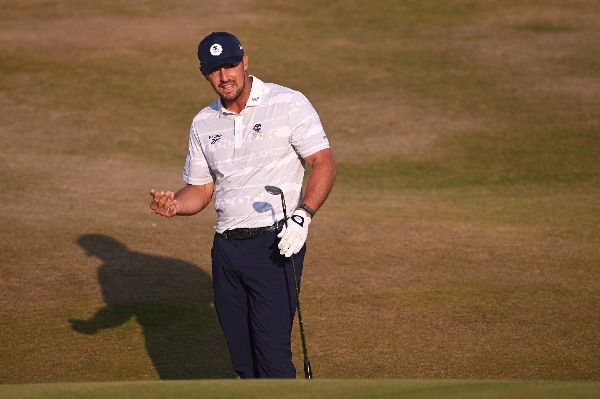
On the fifth hole during the second round, Bryson DeChambeau hit his ball into the heavy native hazard. He went into the brush to identify his ball and prepare for a recovery shot, shifting vegetation and stepping around his lie in the process. To TV commentators and fans watching at home, the awkward movements looked like a clear-cut violation, triggering an immediate social media firestorm.
DeChambeau vehemently objected to the ensuing two-shot penalty, but his fate was sealed by a committee that issued a dry statement reciting the text of the rule and nothing more. Like the Niemann infraction, this ruling is deeply subjective. Who defines what "firmly placing your feet" means, or what constitutes a "reasonable" amount of digging? Through 54 holes at Royal Birkdale, DeChambeau sits six shots off Sam Burns’ lead — a deficit directly manufactured by that penalty.
The lack of consistency becomes glaring when looking at other infractions on the property. During Friday's second round, Spain’s Jon Rahm threw a club in pure disgust on the 15th hole. Two holes later, he was issued an official warning under The Open's serious misconduct policy.
The R&A offered no explanation as to why Rahm received a harmless warning while Niemann received a tournament-altering two-shot penalty for the exact same physical action a month prior.
Earlier in the week, R&A CEO Mark Darbon was asked about the Niemann issue and how his organization would handle similar conduct offenses. Darbon explained that the R&A had rehearsed several scenarios, but when pressed on whether they would publicly disclose video evidence to justify a penalty, his response was concerning:
“I think it would depend on the context, but I think what's important is that we have clear rationale and explanation for any choices that we make under the umbrella of that policy.”
Golf fans and players aren't asking for rules to be ignored; they are asking for transparency. If a governing body penalizes a player in a major championship, they must provide the public with the exact video evidence used to make the call.
The current system relies too heavily on preconceived notions and behind-closed-doors finality. The governing bodies must come together to establish a codified, universally understood system to address player conduct—perhaps something as simple as soccer's yellow and red card system.
Mark Darbon used the word "transparency" multiple times during his state-of-the-organization press conference. If the governing bodies want to maintain the integrity of golf's biggest stages, it is time for them to finally practice what they preach.