
LAHINCH, Ireland — One of the most endearing traditions of golf across the United Kingdom and Ireland is naming every single hole on the course. Lahinch Golf Club is no different with distinct monikers like Klondyke, Blind Hookey and Brud’s Vision.
The course's origins trace back to March 1892, when Alexander W. Shaw and Richard J. Plummer surveyed the County Clare coastline, founding the club a month later. In 1894, Shaw funded a trip to bring Old Tom Morris to Ireland to redesign the initial layout.
Morris placed eight holes on the seaward side of the road and the remaining 10 on the inland side. Today, only Hole 4 (Klondyke) and Hole 5 (The Dell) remain as surviving Morris originals. George Gibson modernized the layout in 1907 by adding three seaward holes, before Dr. Alister MacKenzie completely reshaped the Old Course in 1927, integrating the towering sand dunes to bring the entire routing onto the ocean side of the property.
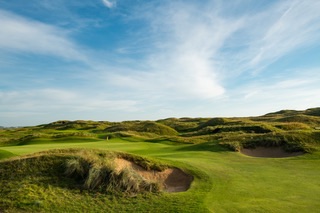
The names of the holes under the Morris changes in 1894 were: The Sea, The Bents, The Valley, Paradise, The Dell, Blind Hockey, Liscannor, The Saucer, The Bay, The Bridge, Crater, Hilly, Rushy, Sandy, Pons Asinorum, Ennistymon and Home.
As the physical layout evolved, so did the hole names. Following MacKenzie's 1927 redesign, the 18 holes were officially ordered as: 1. MacKenzie, 2. Village, 3. Cillstifiann, 4. Klondyke, 5. Dell, 6. Paradise, 7. Blind Hookey, 8. Crater, 9. Burke’s Corner, 10. Goats, 11. Liscannor, 12. Castle, 13. Mine, 14. Valley, 15. Brud’s Vision, 16. Old Tom, 17. Pons Asinorum, 18. Shaw.
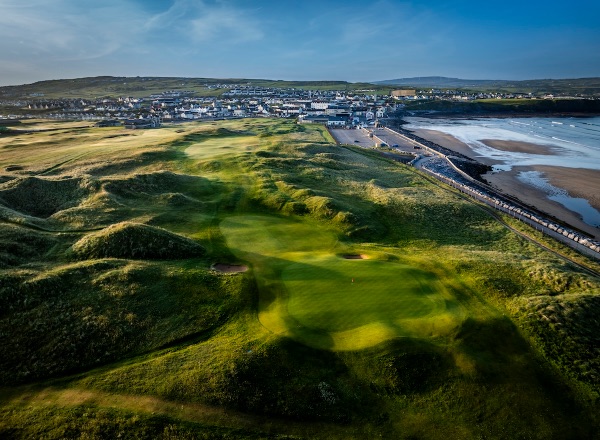
While many names reflect physical terrain, others carry rich local mythology and historical pedigree:
Hole 3 (Cillstifiann): Named after a mythical town submerged in Liscannor Bay. According to The Annals of the Four Masters, which chronicles Irish history, a biblical flood engulfed the town in 1616 AD. Local lore warns that anyone who views the sunken village in calm waters will die within seven years.
Hole 7 (Blind Hookey): A sharp dogleg left that demands a completely blind tee shot over high dunes — a fittingly ominous name for an unseeable fairway line and quick turn.
Hole 9 (Burke’s Corner): Honors Sean (John) Burke, Lahinch’s greatest amateur and one of 54 Irish golfers to represent GB&I in the Walker Cup (1932).
His golfing bio is impressive:
Irish Open Amateur Champion (1947)
Irish Close Champion (1930-1933, 1936, 1940, 1947-1948)
South of Ireland Champion (1928-1931, 1939, 1941-1946)
West of Ireland Champion (1933-1934, 1936, 1938, 1940-1941)
Walker Cup player (1932)
Irish Open (1933, low amateur)
Irish International (1929-1938, 1947-1949)Hole 15 (Brud’s Vision): Dedicated to long-time club secretary Brud Slattery ("Mr. Lahinch"), who defeated Burke in the 1947 South of Ireland final. During his 30-year tenure starting in 1954, Slattery famously leveled a massive sand hill on the 15th to open up the fairway view. He initiated Castle course development from nine to 18 holes, and extended the clubhouse.
Hole 17 (Pons Asinorum): Latin for "Bridge of Asses or Donkeys," stemming from Euclid’s geometric theorem on isosceles triangles. In modern parlance, Merriam-Webster defines it as "any critical test of ability, understanding, or a stumbling block that separates capable thinkers from incapable ones.” In terms of geometry, the theorem that the angels opposite the equal sides of an isosceles triangle are themselves equal is known as the pons asinorum.